
A plant manager is not worried about whether you can build it. He worries about his line while you do.
Construction in an operating facility, from expansions to shutdown work, puts your crew a few feet from people still making product. The owner has three fears: you stop production, contaminate the product or hurt their people.
The first has a price. In its 2024 True Cost of Downtime report, Siemens put one hour of unplanned downtime at a large automotive plant at 2.3 million dollars.
Why the owner screens so hard
The owner's name is on your safety record too. Under OSHA's multi employer citation policy, in effect since December 1999, more than one employer can be cited for the same hazard. The employer controlling the site must take reasonable care to prevent and detect violations, and may need to inspect more often with a contractor it has never used.
So the first meeting is paperwork: EMR, OSHA logs, written programs, insurance.
What owners check before you get inside
Safety record and orientation. In ABC's 2025 safety report, contractors that gave new employees an in depth orientation had recordable incident rates 52 percent lower than those with compliance only orientations. Expect the plant's own training on top.
Phasing around shifts. Writing in Area Development, John Wharton of Gresham Smith tells owners to start construction shifts at least one hour before production shift changes, and to plan outages well in advance. A tie in waits for the shutdown window.
Dust and contamination control. OSHA's silica rule for construction caps exposure at 50 micrograms per cubic meter over an eight hour day, and bars dry sweeping where it could add to exposure. In a food plant, FDA's draft Listeria guidance from January 2017 warns that construction can disrupt air patterns, and recommends temporary barriers that isolate the work.
Logistics. Where you park, stage, enter and cross a forklift aisle. Wharton's rule is hard barriers for vehicles, light barriers for people.
Communication with operations. One person on each side owns coordination, and you meet daily. Under OSHA's lockout standard, the plant and an outside contractor must also share their lockout or tagout procedures.
No surprises. When something slips, the plant hears it from you first. Wharton's advice for an unavoidable delay is to "inform everyone immediately and start replanning."
How you prove you can do it
A safety manual promises all of that. An owner who has never worked with you cannot see it. Video and photos of your crew working inside a live plant, under its rules, can. That is what construction video production should be: plain footage, not a commercial.
Film the rules being followed. Barriers up, PPE on, the escort at the door, the cleanup at shift end.
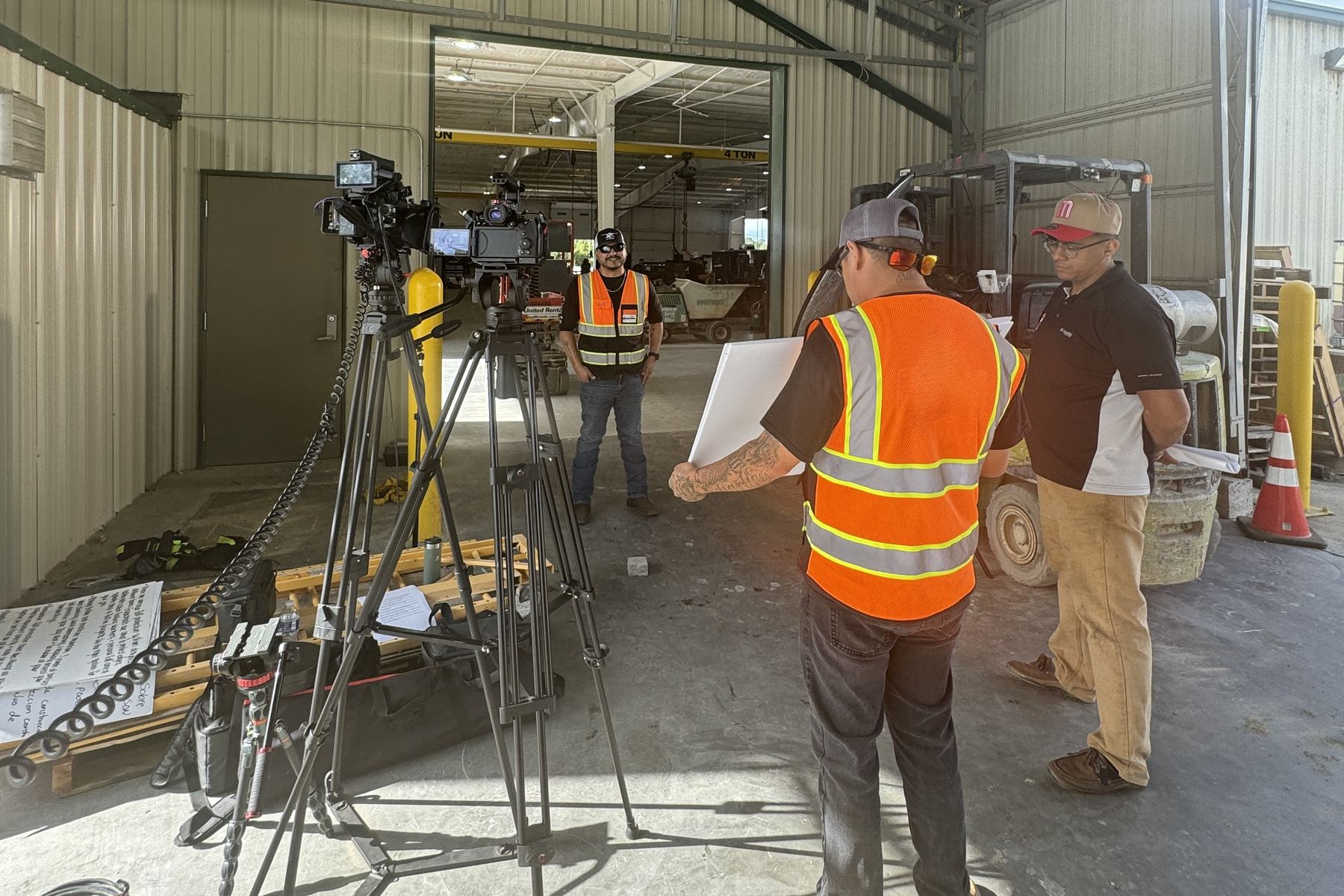
Put the superintendent on camera. How the phasing worked, how the tie in fit the window, and who heard first when something slipped.
Put the plant manager on camera. An owner believes another owner. Ask why they let you in and how it went.
Use it where the decision happens. Private qualification packages, shortlist interviews, the email after a site walk. A ninety second link in your statement of qualifications forwards well to people who missed the meeting. On public work, follow the rules on extra materials.
What it looks like from our side
We have not filmed a tie in on a live production line. Our nearest example is a painting job.
EcoFiber, a manufacturer in Colfax, hired JD Paint Pros to prime and paint a 50,000 square foot former machine shop still full of equipment. Over twelve days, the equipment was moved section by section.
We filmed day three, with the person at EcoFiber who made the hiring decision and the crew at full scale, and day ten, with Carlos, who built the company. The piece runs under two minutes, and he sends it to nearly everyone who asks about a building.
It was not a running plant, but it shows what an owner wants: a crew working in a manufacturer's building, and the person who hired them saying why.
The filming does not take a week. For Aspen Irrigation, three or four hours filming the crew on a full install, plus the founder's story, became a two minute film the owner has sent to prospects for years.
When we film in a plant, its rules apply to us too. If the plant manager asks whether filming will disrupt production, the answer is short: interviews take about twenty minutes each, and no line stops for a shot.
What video cannot do
Proof of past work helps you make the short list. The safety record, the references and the price still decide the job.
No film replaces an EMR, a prequalification form or a site visit. An owner who sees a great video next to a weak EMR will trust the EMR.
Some plants allow no cameras at all. Ask first, and get the owner's approval in writing.
The short version
Owners fear you will stop production, contaminate product or hurt people, and OSHA can cite them for your hazards.
They check your safety record, phasing, dust control, logistics and communication first.
Prove it with footage of your crew under a plant's rules, and the superintendent and plant manager on camera.
Video helps you make the short list. Your record, references and price still win the job.